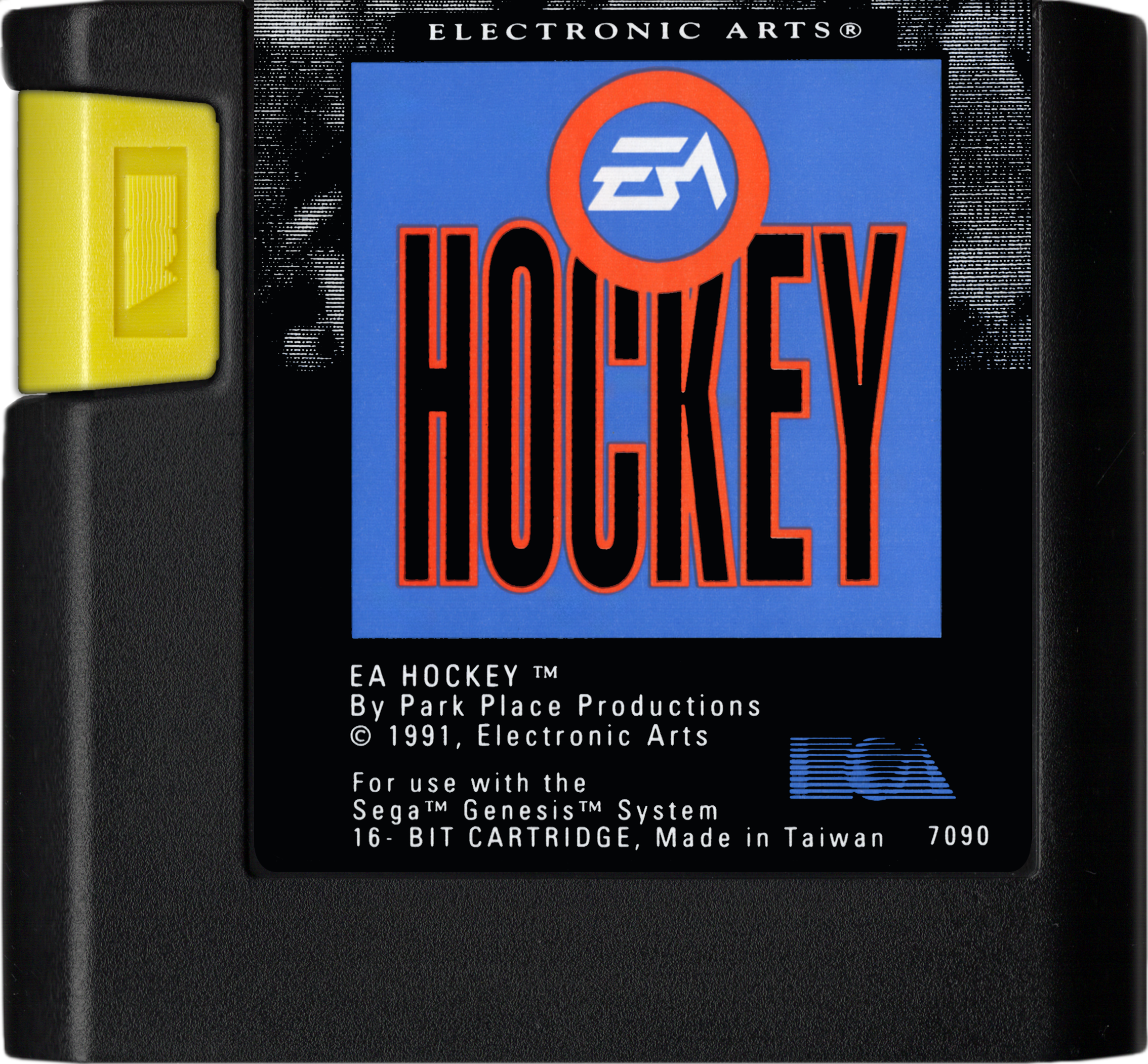
Here is a question worth sitting with for a moment. How many ice hockey fans do you actually know?
Not people who've seen it on the telly. Not people who know what a puck is. Actual, committed, know-the-offside-rule, have-a-favourite-team ice hockey fans. In most parts of Britain, the honest answer is probably not many. The sport exists here, devotedly followed by a dedicated minority and dimly understood by most everyone else. It is not football. It is not rugby. It is, to the majority of British Mega Drive owners, a sport they have watched approximately twice on Channel 4 on a wet Saturday afternoon and found rather exciting without being entirely sure why.
This matters, because EA Hockey is one of the best sports games on the Mega Drive, and there is a reasonable chance you are going to overlook it entirely because of a sport you have never really thought about. Do not do that. This game will convert you.
What EA have done here
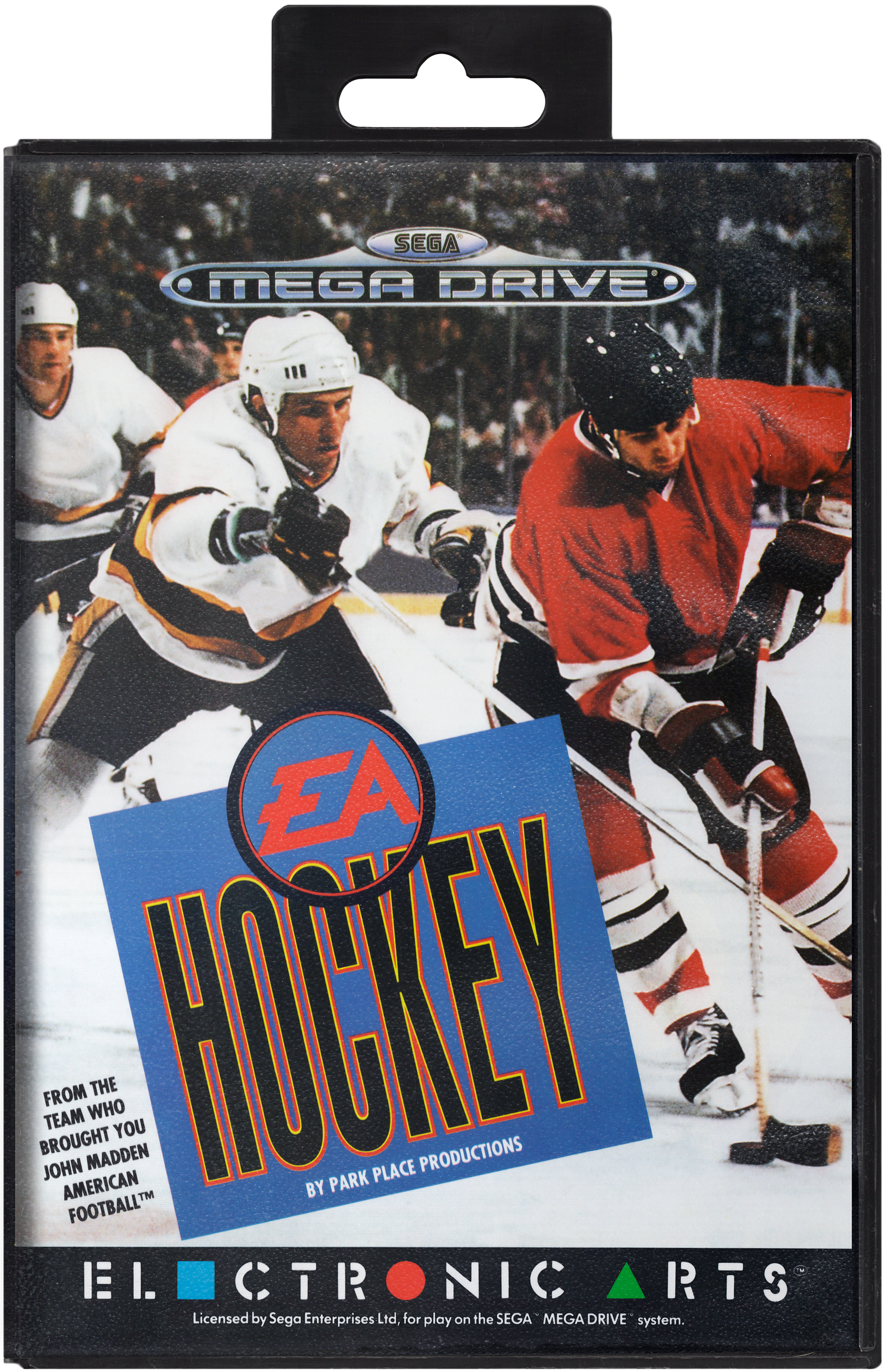
EA Hockey is the second Mega Drive sports simulation from Electronic Arts, the American publisher who demonstrated with John Madden Football that the console could handle a serious, fully-featured sports game without compromising on either depth or playability. The question with EA Hockey was whether they could do it again with a sport that the Americans take as seriously as the British take football, and which the British treat roughly as an interesting curiosity.
The answer is yes. Emphatically yes.
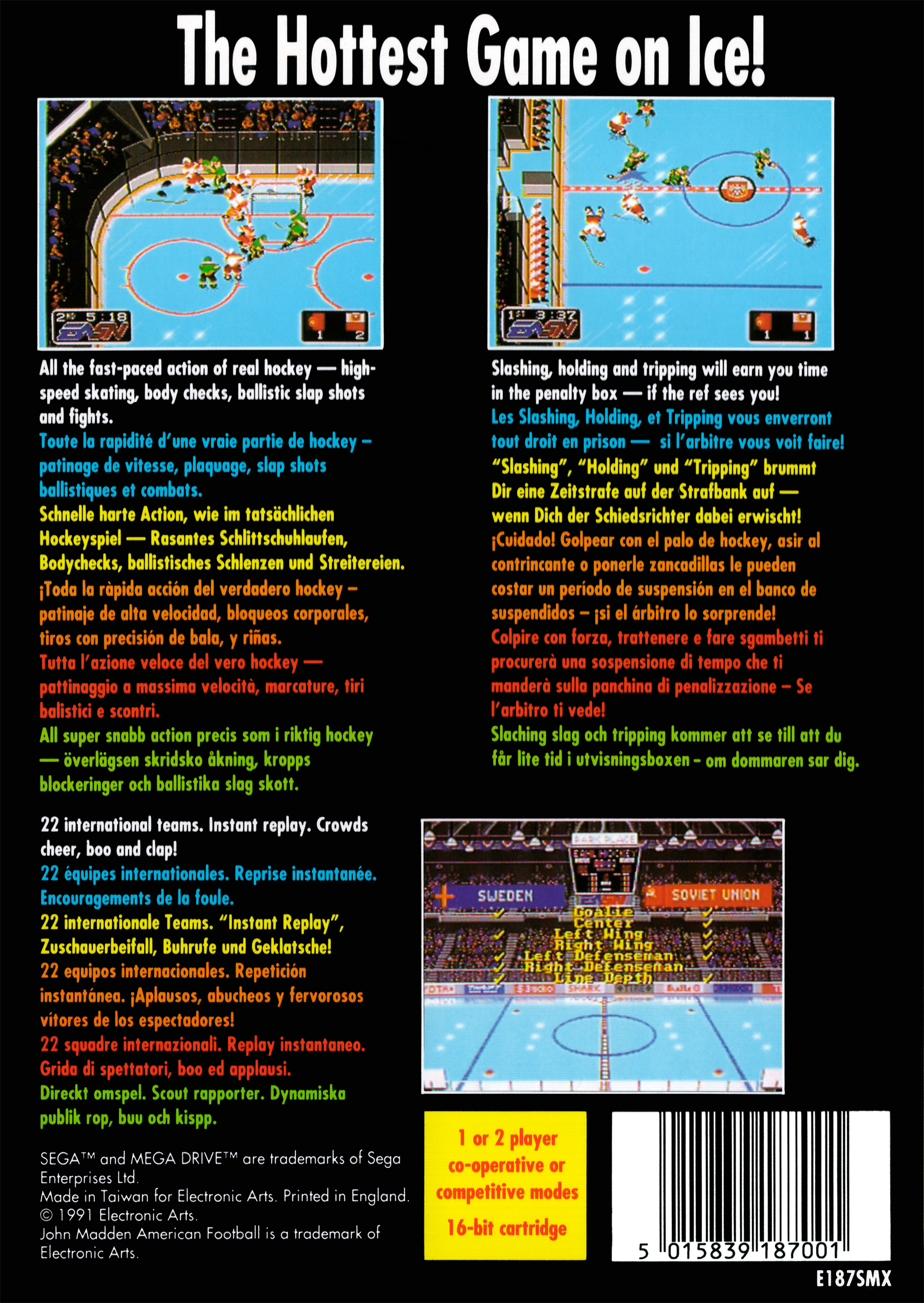
The game is a faithful representation of ice hockey, complete with the full rules of the sport for those who want them, and a scaled-down arcade-friendly version for those who don't. The idea is straightforward: two teams of six, one puck, two goals, and the objective of getting the puck into the opposition's net more times than they get it into yours. Periods replace halves, ends are switched after each period, and the referee is a constant presence, enforcing penalties, calling offsides, and sending the more enthusiastic players to the sin bin for two minutes at a time when they get carried away. If the penalty option is switched on, that is. If it's switched off, the gloves can come off rather more freely. We'll get to that.
Getting into it
The control scheme is sensible and economical. Two buttons handle the majority of what you need: pass and shoot, essentially, with context determining which player you're controlling at any given moment. The player with the puck is indicated by a filled star marker above their head, and pressing the button at the right moment hooks out a stick to collect a pass or launch a shot at goal. At the face-off (the puck drop at centre ice that starts each period and restarts play after stoppages), the B button times your player's lunge for possession, and whoever gets there first has the initiative. It's quick to learn and rewards practice rather than punishing newcomers.
The game moves at a genuinely impressive clip. EA's programmers have captured the thing that makes ice hockey so watchable, even if you don't fully understand it, which is the sheer pace of it. Players skate and accelerate with proper inertia (which is to say, they feel like they have weight and momentum rather than teleporting around the rink), the puck zips across the ice in a way that keeps your eyes tracking constantly, and the rink scrolls in all eight directions with a smoothness that the Mega Drive's hardware should be proud of.
You can have the length of each period set to five, ten or twenty minutes, and the competition adjusted to suit. In single player you choose your team from twenty-two available nations, ranging from the formidable (the United States and the Soviet Union, both of whom will give you a serious game) to the considerably less formidable (Great Britain and Spain are mentioned in the period reviews as teams that essentially cannot play, and this is accurate to their real-world hockey pedigree at the time). Novice players are advised to take one of the stronger nations and work down. Experienced players who want a proper challenge should take Great Britain and see how long they last.
The fighting
Right then. Let's talk about the fighting.
Ice hockey, if you've caught it on television, has a well-documented relationship with the organised scrap. Tensions mount, a shoulder charge goes in a bit hard, someone takes exception, the sticks go down, the helmets come off, and suddenly two men are standing in the middle of a frozen rink taking proper swings at each other while the referee stands at a cautious distance and everyone else watches. It is, depending on your persuasion, either one of the great spectacles in sport or an embarrassing anachronism. EA have included it, and it is one of the best things in the game.
When frustration reaches a sufficient level on the ice, a fight breaks out. Upper cuts, body blows, and the general objective of flooring your opponent before you get floored yourself. It doesn't go on long, a winner is established, the loser hits the ice, and the referee reasserts control. If the penalty option is on, both combatants get a spell in the sin bin. If it's off, everyone just gets on with it. The option to toggle all penalties off and turn the entire game into a fist-enabled orgy of ice-based violence is, predictably, extremely popular. EA have committed to the bit, and the bit is brilliant.
Rob Hubbard
Special mention is owed to the soundtrack, because it is exceptional. Rob Hubbard, the British composer who made his name on the Commodore 64 in the 1980s writing some of the most technically accomplished music the format had ever heard, has composed the music for EA Hockey, and the result is a thumping, atmospheric piece of work that hits the moment the cartridge boots up. It is mean and moody in a way that suits a sport played on ice by people who periodically punch each other. The Mega Drive's sound chip (the FM synthesis hardware that generates the console's distinctive punchy, metallic sound) is in excellent hands, and Hubbard knows how to make it sing. The in-game sound effects, the crowd reactions, the klaxon when a goal goes in, the crunch of a shoulder charge, are all doing real work underneath the music. This is one of the better sounding Mega Drive sports titles on the system.
The action replay
One more feature worth its own paragraph: the action replay. After any significant moment, a goal, a fight, a penalty incident, you can call up a VCR-style replay and watch it back, slowing it down to individual frames if you want. In a game that moves as fast as EA Hockey, where goals can feel like they've appeared from nowhere and incidents can be over before you've fully processed them, the ability to rewind and replay at your own pace is genuinely useful as well as satisfying. The argument about whether that last shot was an own goal or a brilliant finish can now, in theory, be resolved. In practice it will probably just generate a better-informed argument.
The grumbles
The single-player experience has an honesty problem. If you pick a strong team, the computer opponents offer reasonable but not taxing resistance, and wins come without too much struggle. If you pick a weak team for the challenge, the difficulty spike is steep enough to feel punishing rather than fair. The sweet spot for single player is a mid-table nation where the games stay competitive, and it takes a bit of experimentation to find it.
Two-player is where the game actually lives. Head-to-head, each controlling a full team, the game becomes a proper contest of reading your opponent, controlling space, and making the most of your chances in front of goal. This is the version of EA Hockey that will keep you up until midnight arguing about offsides, and it is substantially better than the single-player game. If you have someone to play against, the single-player quibbles are largely irrelevant.
The verdict
EA Hockey is a triumph, and the fact that most British players have no particular emotional investment in ice hockey as a sport turns out not to matter in the slightest. The sport translates to the Mega Drive with its pace, its violence and its spectacle fully intact. The controls are clean, the action is fast, the fighting is a delight, the replay system is smartly implemented, and Rob Hubbard's soundtrack is one of the best on the console. Electronic Arts have now done this twice running with two different American sports, and the pattern is becoming clear: they understand how to make games that play as good as they look.
If you bounced off ice hockey as a spectator sport, give this a go anyway. The game will do the conversion work for you. And if you already love the sport, well, you've already ordered it.
If EA keep making Mega Drive sports games at this standard, they are going to need a bigger shelf.
In hindsight
EA Hockey looks, in retrospect, like the earliest step in one of the more remarkable runs in console sports game history. Electronic Arts would go on to build the NHL series into one of the longest-running and best-regarded sports franchises in games, but the version on this cartridge predates the branding, the licences, and the annual iterations that would define that series. It is the proof-of-concept game, the one that demonstrated the formula worked before the lawyers and the league deals arrived to refine it.
The licensing situation is worth understanding properly. The PAL release of EA Hockey arrived without the full backing of the National Hockey League or its players' association, which meant the teams were national sides rather than the NHL clubs British fans might have caught on television. The North American version carried a licence its British counterpart did not. The following entry in the series, NHLPA Hockey 93, added the players' association licence and with it real player names and stats. NHL 94 brought the full league licence and the complete team rosters, and is generally regarded as the point where the series became definitive. EA Hockey sits before all of that, as the game that made the case the formula was worth investing in. Without this cartridge doing what it did, there is no NHL 94.
Rob Hubbard's contribution deserves a note in its own right. Hubbard was one of the most celebrated composers of the Commodore 64 era, a period in British games development when the severe technical limitations of the hardware forced composers to be extraordinarily inventive, and he carried that inventiveness into his console work. His EA Hockey soundtrack is a reminder that the games music scene had genuine talent in it long before anyone was writing features about it, and it holds up considerably better than most sports game soundtracks of the era.
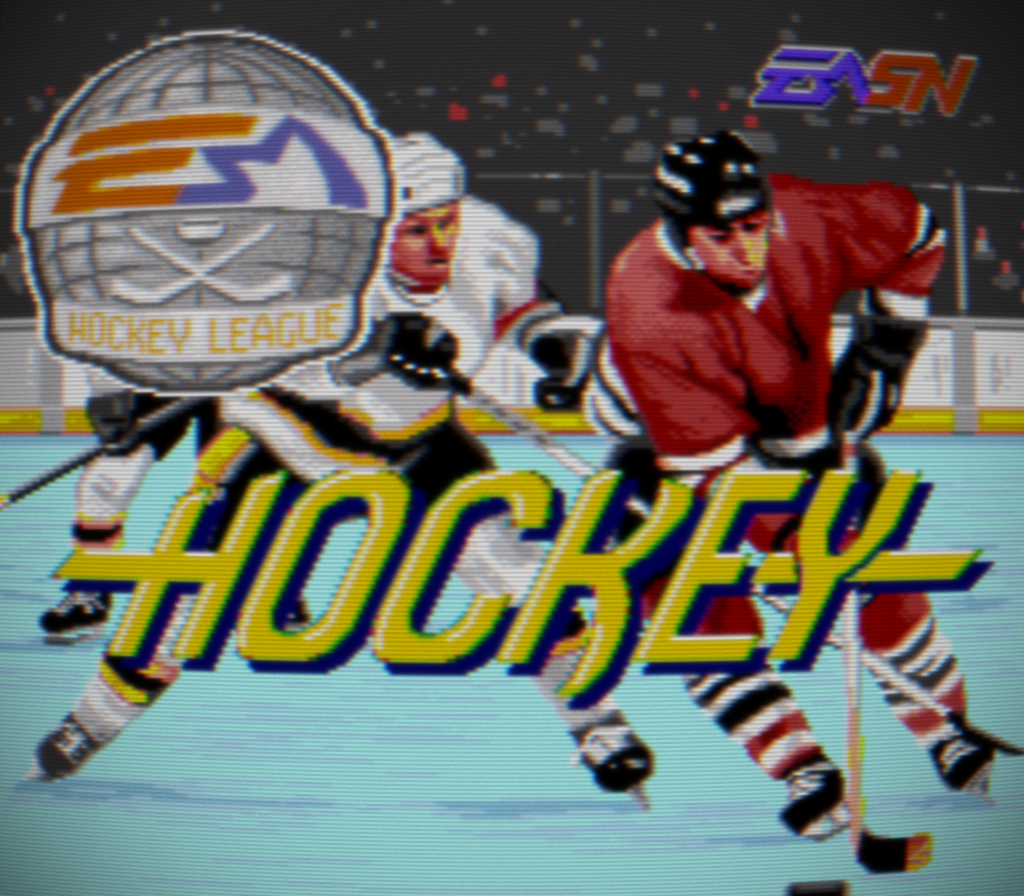
The game itself has aged with the expected limitations of the format: the sprites are small, the rink is obviously tilted rather than truly three-dimensional, and the rules simulation is basic compared to what the series would achieve within a few years. None of that changes what it was at the time. For many British players, EA Hockey was their first real experience of ice hockey as a game, and for some of them it was their first real experience of ice hockey full stop.
 Codex Essential Game