Demolition Man
reviews
Demolition Man the film arrived, did reasonable business, and generated the usual flurry of licensing interest. Virgin picked up the rights first. Then, for the best part of a year, nothing. Rumours circulated that Sony Imagesoft had it. Then Ocean's name got mentioned. By the time Acclaim's logo finally turned up on the box, most people who'd been vaguely tracking the project had assumed it was quietly binned, the way so many movie licences are when the sums stop adding up. It hadn't been. It had just taken the scenic route.
The question worth answering is whether it was worth the wait, or whether this is simply another entry in the crowded genre of "movie licence, mediocre platformer, next."
The set-up
Sylvester Stallone plays John Spartan, a cop from a considerably rougher 1990s Los Angeles, cryogenically frozen alongside his nemesis Simon Phoenix after a rescue operation goes wrong. Both men wake up decades later in a sanitised, pacified future where violence has been engineered out of society, swearing is illegal, and even physical intimacy has fallen out of fashion. Phoenix escapes his rehabilitation programme first and immediately reverts to type. The authorities, lacking anyone on the force equipped to deal with a genuinely violent criminal, defrost Spartan and set him loose to do what he does best.
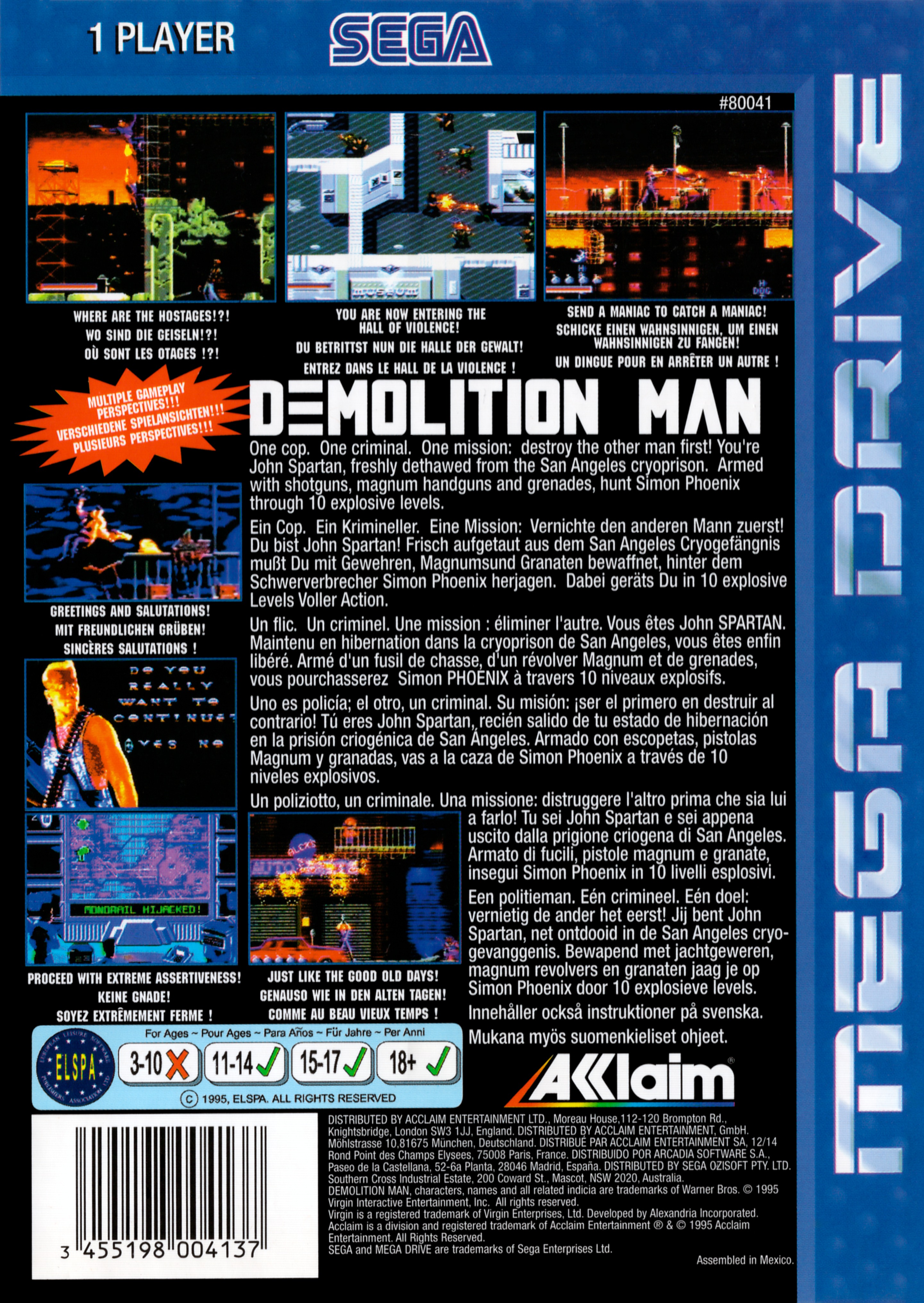
The game follows this plot closely, level by level, which is more than can be said for most licensed tie-ins of this era. If you've seen the film, you'll recognise the beats: the opening bungee drop from a helicopter, the Weapons Museum, the sewer-dwelling underclass living beneath the sanitised city above. It's a faithful adaptation, structurally speaking, even if faithful adaptation and good game design don't always overlap.
What you're actually doing
This is where Demolition Man becomes an interesting case rather than a straightforward one. It is not a single game with one structure repeated across levels. It's several different games stitched together, each borrowed wholesale from somewhere else in Acclaim's back catalogue and reassembled under Stallone's face.
The bulk of it is side-on platform shooting, Spartan working his way across scaffolding, walkways, and industrial scenery, gun raised, taking out Phoenix's gang as he goes. This section runs on an engine that will feel extremely familiar if you've played Robocop vs Terminator, and it isn't subtle about it. The pacing is similar, the enemy placement follows similar logic, the general feel of methodically clearing a screen of hostiles before advancing is close enough to Virgin's earlier licence that you could be forgiven for thinking someone simply reskinned the assets.
Interspersed with this are top-down sections, viewed from above rather than the side, that play more like Gauntlet: navigate an isometric-ish environment, pick up weapons, clear out rooms of enemies. The Weapons Museum sequence, where hostages are held among priceless artefacts and you're encouraged to shoot up the exhibits hunting for power-ups, is the best-remembered of these. There's also a monorail sequence where Spartan runs along the roofs of carriages taking out armed passengers, and a set of "extreme sports" interludes, bungee jumps, death slides, tightrope walks, that exist mostly to break up the shooting with something more physical.
The variety is, on its own terms, a strength. Few Mega Drive platform-shooters bother changing their fundamental perspective and control scheme multiple times across a single cartridge, and the willingness to do so here at least keeps the pace from ever fully settling into a rut. The downside is that none of the individual pieces feel like they were designed from scratch for this game. They feel borrowed, competently reassembled, but borrowed all the same.
How it plays
The core shooting is solid. You can fire in any direction independent of your movement, which sounds like a small thing but matters enormously in a game with this much enemy density; being able to walk backwards while shooting forwards, or fire diagonally while strafing, gives you a level of control that a lot of contemporaries lack. The hit detection is fair, the weapon variety is decent, and the general feel of mowing through waves of Phoenix's crew has a satisfying weight to it.
Where opinion genuinely splits, and we should be honest about this rather than pretending a consensus exists that doesn't, is on how much all of this adds up to. Some reviewers at the time found the game a properly enjoyable blast, fast, varied, and better than the underwhelming film had any right to inspire. Others were considerably less impressed, arguing that what you're actually playing is a patchwork of ideas lifted from better games: Terminator's shooting, Gauntlet's top-down rooms, Earthworm Jim's platforming sensibility, all present in diminished form and none of them quite as sharp as their sources. Both readings have merit. The game is fun in short bursts and genuinely well put together on a mechanical level. It is also, undeniably, not original, and if you've played the games it's borrowing from, you will clock the resemblance immediately and it will colour how generous you feel toward the rest of the package.
How it looks and sounds
The presentation is a clear step up from the muddled, over-dark reputation some Acclaim licences of this period carry. Backdrops vary properly between levels, silhouettes and light flashes give the side-on sections real atmosphere, and the overhead Weapons Museum sequence in particular looks sharp, with a good sense of space that the top-down perspective doesn't always achieve on this hardware. There are complaints from the period that some sections run too dark, and it's a fair one; a handful of the industrial sequences ask a lot of contrast that a CRT of the era wouldn't always render kindly.
Sound is a genuine highlight in places. Digitised speech samples ("send a maniac," "be happy citizen") land well and add real personality, and the death effects have a meaty, satisfying crunch to them. The music does its job atmospherically without being especially memorable, competent rather than a highlight in its own right.
The verdict
Demolition Man is a better game than its convoluted path to release, or the mixed reputation of the film it's based on, would suggest. The shooting is solid, the variety across different perspectives and level types keeps things from growing stale, and the presentation is a cut above the average movie tie-in of the period. It borrows heavily, and openly, from better games that came before it, and depending on your tolerance for that kind of magpie design, you'll either see a competent, generous package or a game with nothing genuinely its own to offer.
Our honest read: it's worth your time, particularly if Robocop vs Terminator passed you by or you simply want more of that formula with a fresh coat of paint. Just don't go in expecting innovation. Go in expecting a solid, well-assembled shooter that knows exactly what it's borrowing and isn't shy about it.
In hindsight
The development history is worth dwelling on, because it says something about how licensed games actually got made in this era. Rights bouncing between Virgin, rumoured interest from Sony Imagesoft, whispers of Ocean's involvement, before finally landing with Acclaim well over a year after the film itself had come and gone. This wasn't unusual. Movie licences of this period were frequently traded, shelved, revived, and reassigned as publishers' priorities shifted, and Demolition Man is a reasonably well-documented case of a game nearly not existing at all before finally emerging, arguably better for the delay than it would have been as a rushed day-one tie-in.
Released in September 1995, this was also a genuinely late Mega Drive title, arriving as attention across the industry was firmly shifting toward the next generation of hardware. Getting a competent, well-reviewed platform-shooter out at this stage of the console's life, rather than a rushed cash-in, speaks reasonably well of the team involved, even if the finished product leans so heavily on the shoulders of Acclaim's own earlier work.
The critical split between the period reviews is worth preserving honestly rather than smoothing over. Scores ranged from a genuinely lukewarm 72% to an enthusiastic 89%, and the disagreement wasn't really about whether the game worked mechanically, most reviewers agreed it did, but about how much originality actually matters when the execution is this competent. It's a reasonable question with no single correct answer, and the Codex would rather present it honestly than pretend a consensus existed that the historical record doesn't support.